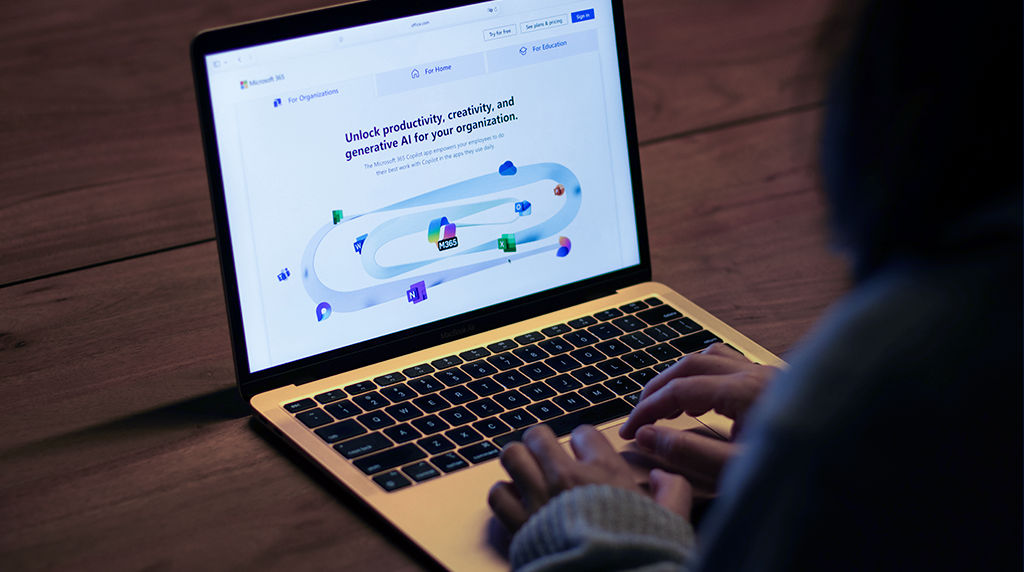
Enterprise technology strategy is entering a different era.
For years, organizations evaluated technology one requirement at a time. Identity had its platform. Endpoint management had another. Security teams added specialized products, while data accumulated across warehouses, databases, software as a service (SaaS) applications, and file systems. Productivity tools evolved separately from many of the systems responsible for managing and protecting them.
That approach created capable technology environments, but it also created fragmented ones.
AI raises the stakes because enterprise technology now depends on how effectively an organization can connect people, data, applications, security, and AI. Advantage will come less from any single model or tool and more from creating a governed system where those capabilities work together.
That is the strategic value of a Microsoft-first approach. It is not about choosing Microsoft for every technology decision. It is about establishing Microsoft as the control plane for the enterprise.
Fragmentation is now a business constraint
Technology fragmentation has traditionally been viewed as an IT problem. It creates more consoles to manage, integrations to maintain, policies to reconcile, and vendors to coordinate.
Today, the impact goes further. Fragmentation limits what the organization can do with its technology.
The result is an environment where:
- Visibility, policies, and configurations fragment across systems.
- Data becomes harder to discover, govern, and use.
- Security response requires coordination across multiple tools.
- AI has to navigate disconnected sources of data and context.
- IT teams spend more time maintaining technology than improving outcomes.
AI makes these limitations much harder to ignore because enterprise AI depends on context.
Who is the user? What are they allowed to access? What information is relevant to their work? Which data can be trusted? What applications can an agent interact with? What actions should it be permitted to take?
Answering those questions requires identity, security, governance, data, and business applications to work together. A fragmented technology environment ultimately creates a fragmented AI environment.
Technology decisions are often made on a product-by-product basis. Organizations evaluate what they use for identity, endpoints, security, data, analytics, and now AI, frequently treating each as an independent technology category.
The better approach is to think about the system those technologies create.
Where is identity established and access controlled? Where are policies enforced? Where is organizational data governed? How do employees interact with enterprise knowledge? How will AI securely access that knowledge and take action across business systems?
Ultimately, where is the control plane?
Microsoft Entra establishes the foundation for identity and access. Microsoft Intune manages devices and endpoints. Microsoft Defender connects security capabilities and signals. Microsoft Purview provides information protection, compliance, and data governance. Microsoft 365 provides the productivity layer where much of the organization’s daily work happens.

Microsoft Fabric can provide a unified foundation for data, analytics, real-time intelligence, and AI-ready information, while Microsoft 365 Copilot, Copilot Studio, and Microsoft Foundry extend AI across that environment.
Each of these technologies provides value individually. Their strategic advantage comes from how they work together.
That is the difference between assembling a technology stack and designing a system.
Why data and AI change the conversation
Security and manageability are important reasons to reduce fragmentation, but data may ultimately be the more consequential reason.
Enterprise data is scattered across business applications, databases, warehouses, analytical platforms, documents, email, meetings, SharePoint sites, and Teams conversations.
AI makes the ability to connect those sources significantly more valuable.
A generic AI assistant can answer questions. An enterprise AI system that understands the employee asking the question, securely accesses organizational knowledge, analyzes trusted business data, and interacts with enterprise applications can become part of how work actually gets done.
This makes the organization’s data architecture inseparable from its AI strategy.
Microsoft Fabric can provide a common foundation for structured and analytical information. Microsoft 365 contains much of the organization’s unstructured knowledge and collaboration context. Microsoft Purview governs that information, while Microsoft Entra provides the identity and access context needed to determine who can use it.
Together, these capabilities create context, and context is what makes enterprise AI valuable.
Microsoft-first does not mean Microsoft only
A Microsoft-first strategy should not become an ideological commitment to using Microsoft for everything. Organizations will still use specialized applications, cloud platforms, data technologies, security products, and business systems where they create meaningful value.
Azure Databricks may play an important role in a data architecture. A specialized security product may address a specific requirement. A line-of-business application may be fundamental to how the company operates.
The objective is not consolidation for its own sake. It is an intentional architecture.
Microsoft becomes the default control plane, and additional technologies are introduced when the value they create justifies the additional complexity.
That creates a useful standard for technology decisions:
Does this capability strengthen the system, or simply add another layer to manage?
What actually changes when the platform comes together
When identity, devices, security, productivity, data, governance, and AI begin operating as a connected system, the benefits extend beyond reducing the number of tools.
Security teams gain better visibility and more consistent signals. IT teams have fewer control surfaces and more consistent policies. Data teams gain a clearer path for making trusted information available across analytics and AI. Employees gain AI experiences grounded in the context of their work.
More importantly, those capabilities can begin working together.
A security decision can incorporate identity and device posture. A data policy can follow information across applications. An AI agent can operate within the same identity, access, security, and governance model that protects the rest of the enterprise.
The organization gains an environment that is easier to understand and easier to evolve.
That is the difference between managing technology products and managing an enterprise platform.
The shift toward agentic AI makes this architecture even more important.
Traditional applications generally wait for a person to initiate an action. Agents can reason, retrieve information, select tools, interact with systems, and take actions on behalf of users or business processes.
That means the enterprise needs to understand who an agent represents, what information it can access, what systems it can interact with, what actions it can perform, and how those actions are governed and monitored.
These are not simply AI engineering questions. They are questions about identity, data, security, governance, and application architecture.
In a fragmented environment, organizations have to solve those problems across disconnected systems. A unified control plane gives AI a foundation to operate from.
As AI adoption accelerates, this becomes one of the strongest arguments for a Microsoft-first strategy. The platform is no longer simply supporting employees and applications. It is becoming the environment where people, data, applications, and AI work together.
Managed services should improve the system, not just operate it
This platform approach also changes the role of managed services.
Traditional managed services are often designed around supporting the environment that already exists. Monitoring, maintenance, ticketing, escalation, and incident response are all necessary functions, but they do not inherently improve the underlying system.
The environment might contain overlapping security products, inconsistent identity controls, redundant management platforms, disconnected data, and unnecessary licensing. A managed service provider can become very proficient at operating that complexity without ever eliminating it.
At Inviso, managed services start with a different objective:
Build the right system, then continuously operate and improve it.
The first step is understanding the environment as a whole: where identity is controlled, how devices are managed, how information is protected, where business data lives, which technologies overlap, where gaps exist, and what capabilities the organization will need as AI becomes more deeply integrated into the business.
From there, we progressively establish a cleaner operating model:
- Reduce unnecessary tool and platform sprawl.
- Standardize identity, endpoint, security, and governance controls.
- Consolidate and govern data where it creates business value.
- Create an architecture that supports automation and AI.
- Maintain a documented baseline that can be measured and improved.
This is not a one-time modernization project. It is an operating discipline.
Managed services then become ongoing system management to keep the environment healthy, secure, cost-effective , and aligned with the business while continuously evaluating what should come next.
Ownership matters. The environment belongs to the client, not Inviso.
That distinction is fundamental because managed services can easily create dependency. Environments can become customized around proprietary processes, provider-specific technologies, or institutional knowledge that exists only within the provider, making future transitions unnecessarily difficult.
We deliberately design for the opposite outcome.
Inviso operates as an extension of the client’s team. We can manage daily operations, monitor security and system health, improve configurations and policies, optimize licensing, evaluate new capabilities, and help the platform evolve. At the same time, the architecture remains understandable, documented, and owned by the client.
If the organization decides to take greater operational responsibility in the future, it should be able to do so without redesigning the environment.
Clients should continue working with a managed services partner because that partner continuously creates value, not because leaving has become technically impossible.
The value compounds over time. The most important part of this model happens after the environment is stabilized.
A connected platform creates a foundation for continuous improvement. Security posture can strengthen as new capabilities become available. Licensing can be optimized as requirements change. Data can be progressively consolidated and governed. Repetitive processes can be automated. Compliance controls can evolve alongside the business.
AI can also move from isolated experimentation into the operating environment.
Microsoft 365 Copilot can use an organizational context to improve individual productivity. Copilot Studio and other agent platforms can automate business processes. Microsoft Fabric can make governed analytical data available to AI experiences. Microsoft Foundry can support more advanced AI engineering requirements.
Instead of becoming another isolated project or another product added to the stack, each new capability builds on an existing foundation.
The identity strategy supports security and AI. The data strategy supports analytics and AI. Governance applies across the system. Improvements to the underlying platform make the next capability easier to introduce.
That is where the value begins to compound.
The transition is incremental
A Microsoft-first strategy does not require replacing the entire environment at once. The transition should be deliberate, sequenced, and grounded in the current environment so that the organization can move forward without unnecessary disruption.
A practical path usually starts with understanding the system as it exists today. That means assessing identity, endpoints, security, productivity, data, applications, licensing, and AI to identify overlaps, gaps, risks, and opportunities for consolidation.
From there, the organization can strengthen the Microsoft foundation across identity, access, device management, security, governance, and core platform capabilities. Once that control plane is in place, redundant technologies can be reduced, policies aligned, data connected, and the architecture simplified where doing so creates measurable value.

That foundation then becomes the launch point for higher-value capabilities. Governed analytics, trusted data consolidation, Copilot experiences, automation, and AI solutions can be introduced into a more coherent environment rather than layered onto disconnected systems.
The work does not end once the foundation is established. The environment needs to be continuously operated and improved so that security posture, cost, capabilities, and platform decisions evolve with the business.
The real point
Microsoft-first is easy to misunderstand as a vendor preference or a consolidation strategy.
Identity, endpoints, security, productivity, data, governance, automation, and AI are becoming increasingly interconnected. Managing each as an independent technology category creates complexity at exactly the moment organizations need those capabilities to work together.
The strategic question is no longer simply, “Which tools should we use?”
The better question is, “Do we have a platform that allows us to securely connect our people, data, applications, and AI, continuously improving how they work together?”
A Microsoft-first strategy creates that foundation, not because Microsoft needs to provide every capability in the environment, but because the enterprise needs a control plane.
Pair that control plane with a managed services model focused on continuously improving the system rather than simply maintaining its components, and the organization gains something much more valuable than technology support.
It gains an enterprise platform that is easier to secure, operate, evolve, and ready to support what comes next.
Let’s talk. Ready to see what a Microsoft-first platform could look like for your business? Reach out to us at info@invisocorp.com and we’ll help you build it.